There’s a calendar invite from your manager with no subject line. Just your name and theirs, first thing tomorrow morning. In sales, that usually means one of two things. And if quota has been slipping for two quarters, you already know which one.
That thing is called a Sales PIP.
A Sales PIP, formally known as a Performance Improvement Plan, is one of the most misunderstood tools in the profession. Reps treat it as a countdown. Managers often use it that way. Somewhere between the HR paperwork and the panic, the actual purpose disappears.
Here is a clear-eyed look at what a sales PIP really is, what the numbers say about whether it works, and what both sides of the table should actually do next.
|
TL;DR What is a Sales PIP? Why do reps end up on PIPs? Is it always a sign you’re being fired? Can you survive one? What should managers do differently? |
The Sales PIP: Nobody Wants to Explain It and Fewer Understand It
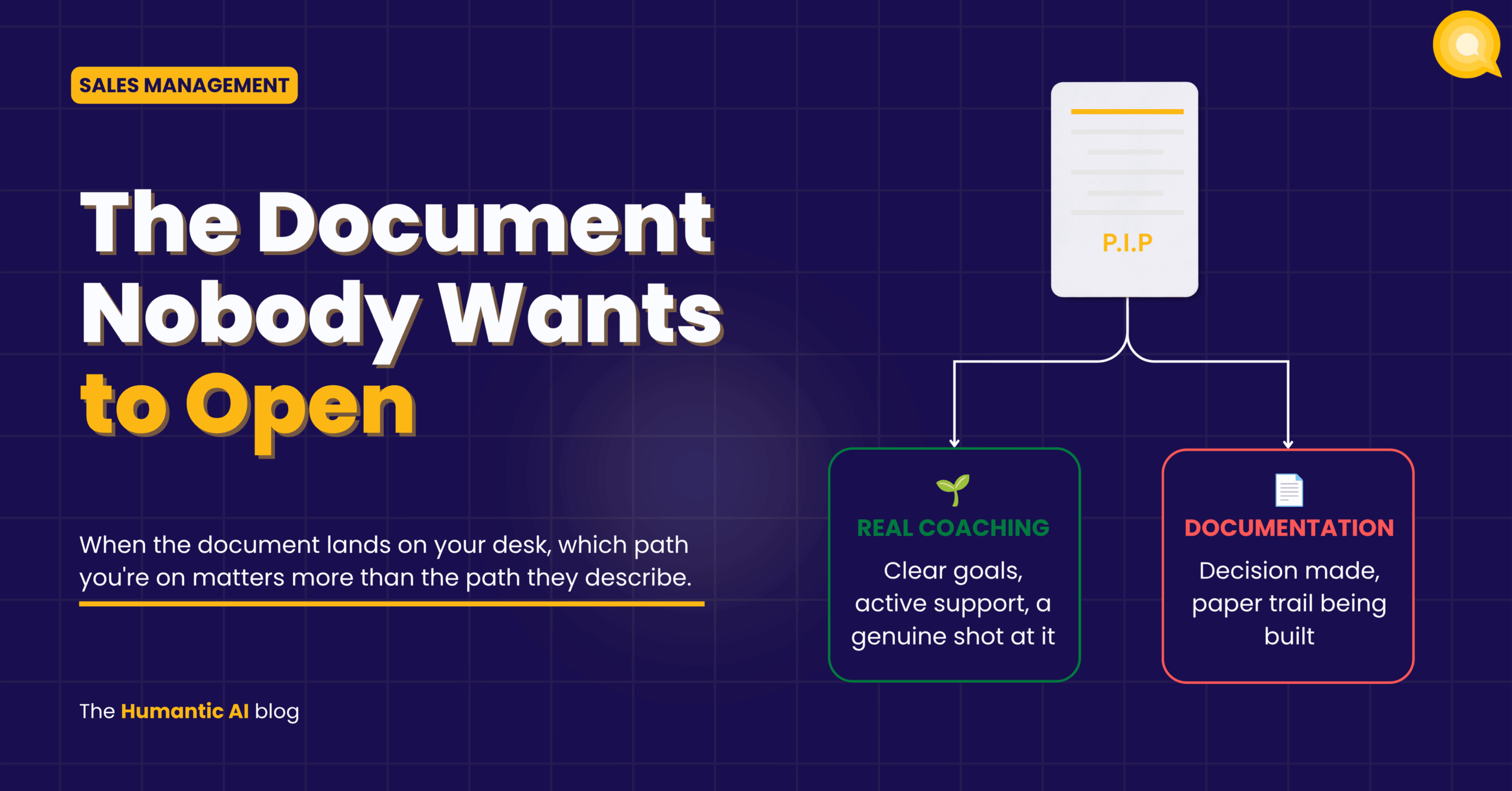
A PIP is usually one of two things.
Either it’s a genuine attempt to fix performance, with clear goals and real support. Or it’s documentation, where the decision has already been made and the PIP exists to formalize the exit. Most reps figure out which one they’re in very quickly. The mistake is responding the same way to both.
When the Math Was Never in Your Favor
The most common trigger for a PIP is sustained quota underperformance. But the data heading into 2026 makes this conversation much more complicated.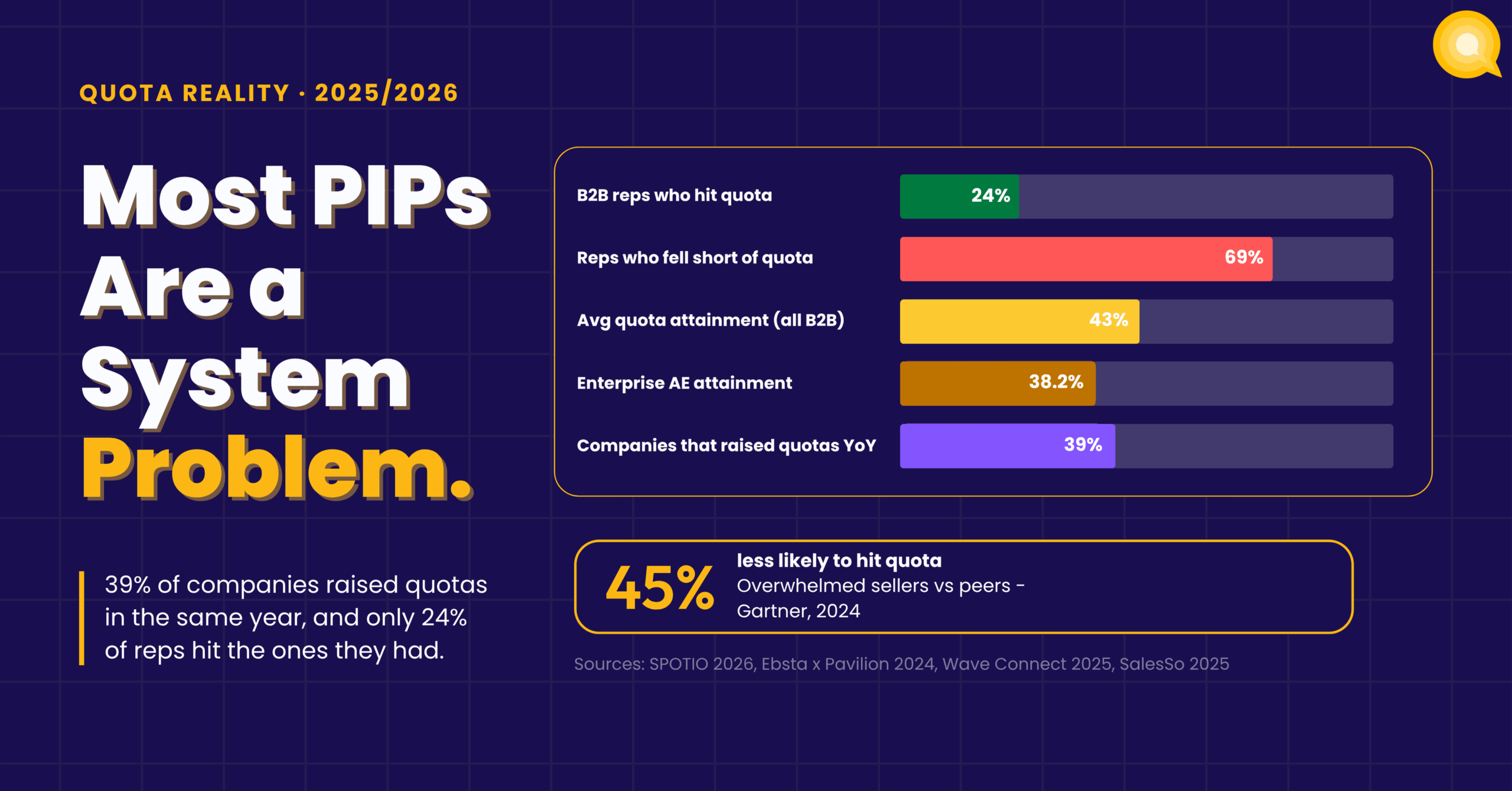
When 39% of companies are raising quotas year over year (SPOTIO, 2026) into a market where only 24% of B2B reps are hitting quota (Ebsta x Pavilion, 2024), many of the people receiving PIPs are underperforming inside a system built to produce underperformance.
That does not excuse sustained low performance. It does mean that before a PIP is initiated, the right first question is: is this a rep problem or a setup problem? One is fixable with coaching. The other requires structural change no PIP will deliver.
You Could Have Seen This Coming Months Ago
Most reps don’t receive a PIP after one bad month. They get there because warning signs went unaddressed across two to four quarters. By the time the document appears, both sides already know something has been off for a while.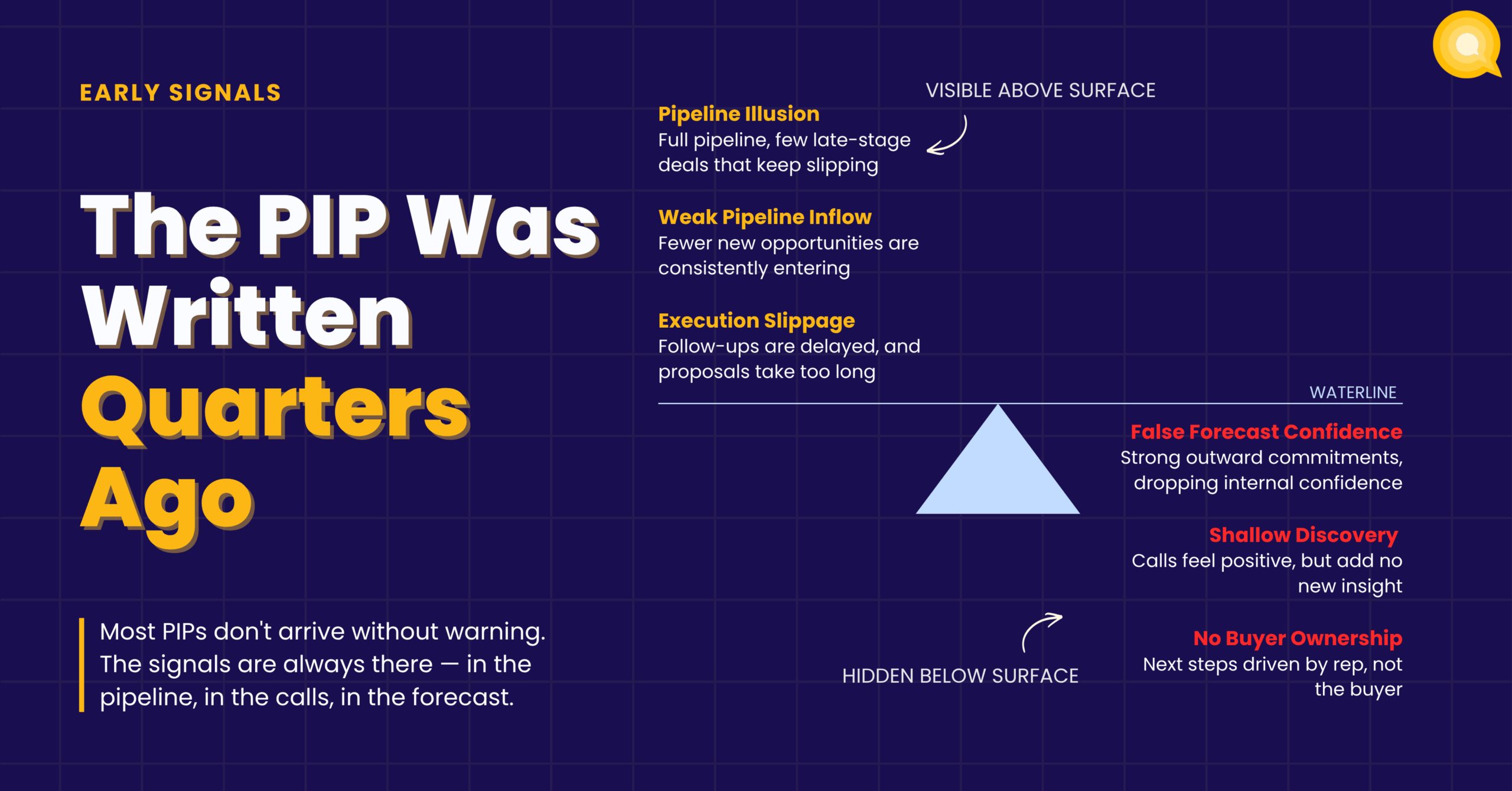 The early signals tend to look familiar:
1. Pipeline illusion: Looks full, but depends on a few late-stage deals that keep slipping.
2. False confidence in forecasts: Commitments stay strong outwardly, but internal confidence drops.
3. Weak pipeline inflow: Fewer new opportunities entering consistently.
4. Shallow discovery: Conversations feel positive but add no new insight.
5. Lack of buyer ownership: Next steps are driven by the rep, not the buyer.
6. Execution slippage: Follow-ups get delayed and proposals take longer than they should.
These are not signs of a bad rep. They are signs of a rep whose system has lost precision. A PIP that ignores the system-level causes and treats the rep as the only variable will not produce a different result.
The PIP That Became the Best Thing to Happen to a Career
Sales culture does not celebrate PIPs. No one posts screenshots of 60% attainment quarters. No one shares the months where the effort was high and the deals didn’t move. But occasionally, a different kind of story breaks through.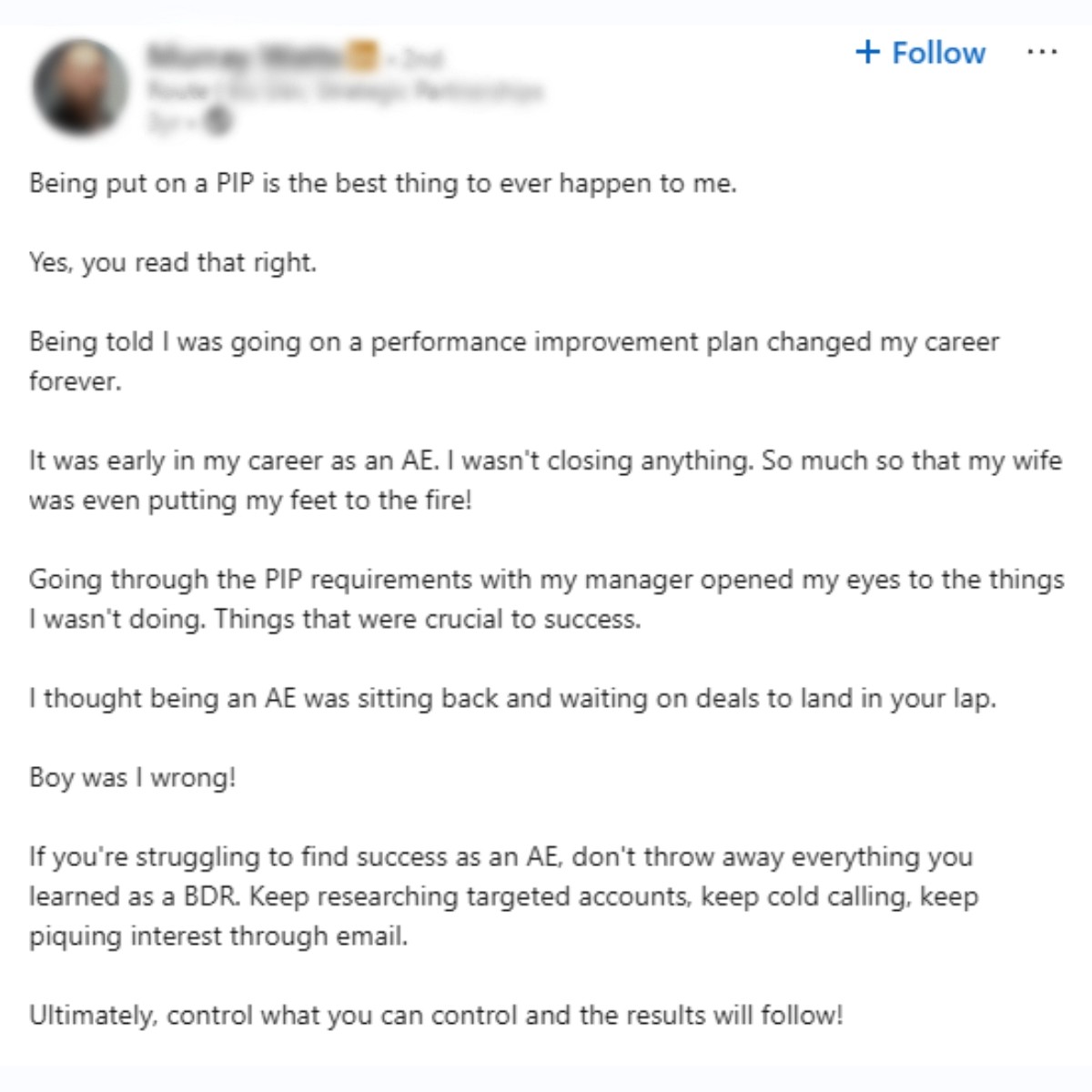
One rep’s story is the exception. He was early in his career, the gap was execution-based, and his manager built the plan around clarity rather than exit. That combination is rarer than it should be. But it is the clearest illustration of what a PIP can do when it actually functions as intended.
You Signed the PIP. Here Is What to Do Next.
Start by understanding what you’re dealing with.
Vague goals, limited support, and timelines that don’t match your sales cycle point to documentation.
Clear goals and an engaged manager mean it’s a real opportunity to improve.
In a real PIP, focus on tightening execution. Track your deals, improve how you qualify, and communicate progress clearly. In a documentation PIP, start planning your exit early so you stay in control.
How to Run One That Is Not Just Legal Cover
Most managers don’t enjoy this conversation. That is probably healthy. If it feels easy, something important is being missed.
Before initiating a PIP, ask whether this is a rep problem or a systems problem. According to Gartner’s 2024 survey of over 1,000 B2B sellers, overwhelmed sellers are 45% less likely to hit quota than their peers. If a rep is underperforming inside a bloated, confusing sales environment, the accountability is pointing at the wrong person.
A PIP built to work needs four things: measurable targets, manager coaching commitments written into the document, a timeline that fits the actual sales cycle, and outcomes stated clearly in both directions before anything is signed. A 30-day PIP inside a 90-day sales cycle is functionally a termination notice with extra steps.
The managers who consistently avoid getting to this point at all are the ones who can see deal-level problems before they become performance-level problems.
What Getting It Right Actually Looks Like
Most deals do not die because the rep stopped trying. They die because the rep kept trying the wrong thing.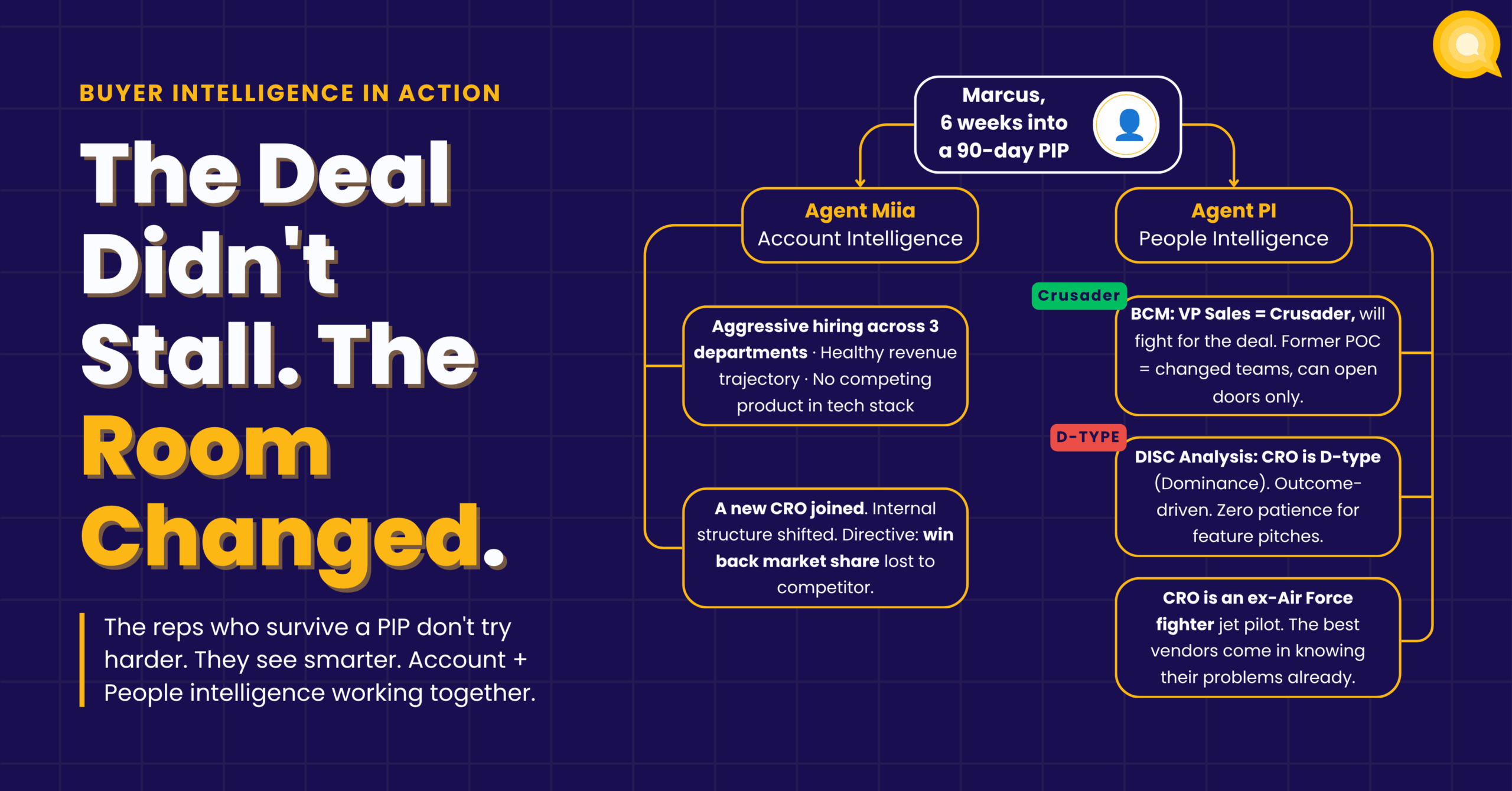
The Deal That Went Quiet Because the Room Changed
Marcus is 6 weeks into a 90-day PIP and one deal has been carrying most of his hope. After the proposal went out, it went silent. His manager assumed budget pushback and Marcus suspected an InfoSec review. Both were wrong. He generates an Account Intelligence report through Agent Miia. It surfaces signals he had not dug deep enough to find himself: a new CRO had joined and the internal structure had shifted. But Miia goes further, hiring data shows aggressive expansion across three departments. When a company is growing that fast, budget is not the blocker. Appetite exists. Miia also pulls their financial signals, revenue trajectory is healthy. On top of that, their tech stack shows no competing product in place, and nothing from any adjacent vendor in that category. The deal had not stalled because of money or fit. The account had simply changed hands. Using Agent Pi on the CRO’s profile, he finds the CRO is a D-type (Dominance): outcome-driven, fast-moving, zero patience for vendors who pitch features instead of speaking to business objectives. He joined with one clear directive: to win back market share lost to a competitor the previous year. Agent Pi also highlights a recent podcast appearance where the CRO talked about how the best vendors he had ever worked with came in already knowing his problems and never wasted a meeting proving their product existed. His public profile goes further: he is an ex-Air Force fighter jet pilot, someone built for high-stakes decisions under pressure with zero tolerance for ambiguity. He then opens the Buying Committee Map (BCM) to map the full stakeholder structure. The VP of Sales is already a power user of the product. In the BCM he shows up as a Crusader, someone who will not just support the deal but actively fight for it. Marcus does not need to convince him. He needs to remind him. The previous POC, once the deal’s strongest internal champion, had changed teams after the restructuring. He can open a door but can no longer push it through. How Marcus Used That IntelligenceMarcus does not send a generic follow-up. He opens his note to the CRO referencing the podcast, adds a line asking about his experience as an Air Force pilot to make it personal, then maps in four sentences how this decision connects directly to the market share mandate the CRO walked in with. Every other vendor was still sending product decks. He was speaking to the CRO’s core objective for the year. The VP of Sales gets a short note, not a pitch. A reminder of what he already knows the product does and what it would mean embedded across the team he now leads. The previous POC gets a brief message, not a pitch, just an ask to give an introduction to the CRO and the VP of Sales. The CRO replies and CCs the VP of Sales. A call is scheduled within days. The deal moves to legal shortly after. Marcus still has work ahead, but for the first time in 6 weeks the deal is alive, the right people are in the room, and he has a real shot at walking out of the PIP with his number intact. Reps who use Humantic AI across buying committees have seen a 109% increase in pipeline, a 16.2% lift in closed revenue, and a 36.5% improvement in deal velocity. The ones who come out of a PIP with their number intact are almost always the ones who stopped selling a product and started becoming experts in the customer’s business. |
That shift did not come from doing more. It came from seeing the deal clearly, both the account and the people inside it.
That is where Humantic AI comes in. Agent Miia brings account intelligence, surfacing what is actually happening inside the company so reps are not walking in blind. Agent Pi brings people intelligence, helping reps understand how each stakeholder thinks, decides and communicates.
Together, they give you both sides of the deal. These two agents combined are what we call buyer intelligence.
The Fixes That Work Before It Gets to This
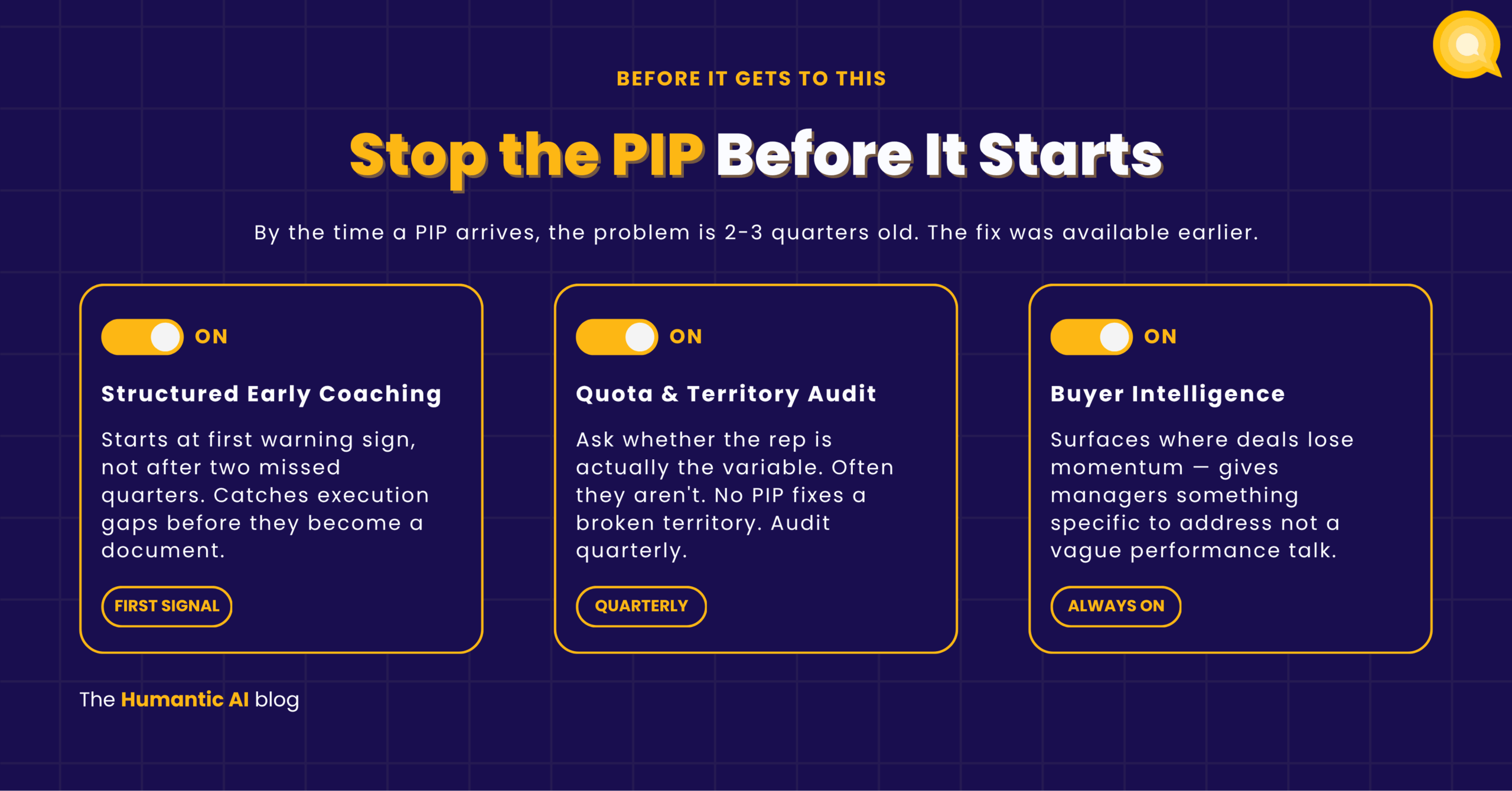 The most effective alternatives to a sales PIP are early coaching, quota audits, and buyer intelligence. By the time a PIP lands, the problem is usually 2 to 3 quarters old. The fix was available much earlier.
3 things consistently work better than a formal plan:
1. Structured coaching that starts at the first warning sign, not after two missed quarters, catches execution gaps before they compound into a document.
2. Quota and territory audits that ask whether the rep is actually the variable. In many cases they are not, and no PIP will fix a broken territory.
3. Buyer intelligence that surfaces where deals are actually losing momentum, giving managers something specific to address rather than a vague performance conversation.
None of these remove accountability. They just move it to a point where something can still be done about it.
FAQs
What is a performance improvement plan (PIP)?
A sales performance improvement plan (PIP) is a formal document that defines specific performance gaps, sets measurable targets, and gives a rep a defined window to course-correct, typically 30 to 90 days.
Is a sales PIP always a sign you’re about to be fired?
A sales PIP is not always a sign you are about to be fired, but the correlation is real. PIPs serve two purposes: a genuine improvement framework or pre-termination documentation. The specificity of the goals and the coaching support offered usually tell you which one you are actually in.
Can the quota itself cause underperformance?
Yes, the quota itself can cause underperformance, and more often than the PIP conversation acknowledges. As of 2025, only 24% of B2B reps hit quota, while 39% of companies raised quotas that same year. A PIP that treats the rep as the only variable is frequently starting from an incomplete diagnosis.
What are realistic alternatives to a PIP?
Structured coaching programs that intervene early, territory and quota audits, and tools that surface buyer-level performance signals before they compound into formal underperformance. Earlier intervention costs less in morale, time, and organizational friction than a formal plan almost always will.
How This Usually Ends
A PIP is rarely the beginning of a story. By the time it lands on a desk, months of signals have already pointed this direction. Slipping forecast confidence. Deals stuck at the same stage. A rep who has gone quieter in team meetings.
Sales organizations that catch those signals early do it through better insight, not more oversight. If you are navigating a sales slump before it reaches this point, this breakdown covers the signals that show up months earlier. Into what is driving individual performance, where quota assumptions are out of step with market reality, and how well reps actually understand the buyers they are trying to win.
Whether you are navigating a difficult stretch or trying to run this process well as a manager, clarity is the asset that matters most. Clear expectations, clear coaching, and clear decisions about what comes next.
If you want to give your team the buyer intelligence to catch those problems before they ever require a formal document, Humantic AI is built for exactly that.
Written by Humantic AI’s marketing team.